Monday, March 22, 2010

the economy

A particularly popular mechanism to stimulate the Haitian economy after the earthquake seems to be cash-for-work. This is an approach, used by many UN agencies and NGOs, to put money into people's hands by paying them for specific activities. The way we do this normally is to invite a community to identify a project that needs to be done and ask them to put forward teams of workers, normally in groups of ten, to carry out this work. Projects can be rubble clearance, digging out the drains in anticipation of the rainy season, or anything else. We pay them 180 Gourdes per day, the equivalent of around US$ 5,-, which is some 10 to 20% below the minimum wage. If we would pay more, we would undermine the normal market mechanism to get people to work, and the cash-for-work schemes are really only meant to augment the labour market, in an environment where unemployment is very high and casual employment - day labourers - the rule rather than the exception.

Not everybody is wildly enthusiastic about this approach. An often-heard criticism is that agencies forfeit their responsibility to design and implement recovery and rehabilitation projects, leaving it to the local population instead. I am not sure about that argument, I have often argued for making people decide themselves what they want to spent their money on, although admittedly there are limits here, too: individual decisions may not always be in the best interest of an entire society, or even a family. A bigger risk, especially because there appears to be little coordination among agencies other than agreeing on the payment levels, is that such cash-for-work approach fuels inflation by pumping enormous amounts of new money into the society. Haiti is a dual-currency economy, using both local Gourdes as well as US dollars, so even without printing money, considerable damage can be done. I am not an economist, but it would be good to create some sort of oversight for this type of programs, and some form of analysis into its impact. Surely, there must be some level of cash input that would start to do harm to the still fragile markets not yet sufficiently supplied.

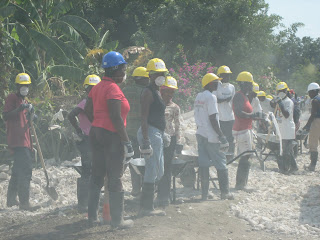
photo: a particularly bad picture, taken through the car window, but it shows a typical cash-for-work crew, with distributed equipment including very uncomfortable boots and hardhats for no clear purpose - except for the T-shirts, most crews have conspicuous T-shirts telling the world who is paying these people. I will get some better photos, plenty of opportunities around.

Sunday, March 21, 2010

the distribution

In one of my previous contributions to the better understanding of Haiti in the aftermath of an earthquake - perhaps I adopt this as a subtitle to my blog - I mentioned distributions, of food and of NFIs. Since you may already have forgotten again what NFIs are, I'll concentrate on food. You will understand that immediately after a disaster of this magnitude you save lives by distributing food and water, people have no access to their normal outlets. Chile was no different, a few weeks ago, and neither is any other sudden natural disaster. However, sometimes it makes sense to continue the food distribution. In the weeks after the Haitian earthquake food was in fact available, but scarce, which drove up the prices. The so-called surge, arranged by WFP, the food arm of the UN, then flooded the market through what we call blanket-distribution (to everybody) early February to bring prices down again, and indeed succeeded. And now, a month later, we have started further food distributions, this time targeted to poor households, women-headed families, elderly people or simply people that have been particularly badly hit by the disaster. They just don't have the means to buy food yet.

Before the earthquake some 70% of Haiti's food was being imported: this country just can't grow enough by itself. Hundreds of years of deforestation have resulted in a bare and treeless countryside, mountainous, and by now deprived of top soil (remember the rains I mentioned?). What the earthquake did destroy was the established imported food chain, which goes from importers via wholesalers to retailers to the ever-present Madam Saras, the women selling small stock in the streets, under umbrellas or from wooden stalls. The importers have lost their ability to bring in food because of a damaged harbour, or a harbour now swamped with disaster relief goods (those NFIs, again). The wholesalers lost their warehouses - or are renting them out for astronomical amounts of money to the many aid agencies that have entered the country. The retailers have lost their shops, and often unsold stock, and the Madam Saras had bought on credit and haven't been able to pay off their debts yet. In addition, nobody is prepared to take business risks in a market that is so fluid, and nobody wants to keep too much stock in an environment where people that have a history of getting violent are hungry.

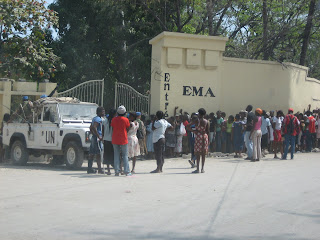
Anyhow, long introduction, but distribution of food is still a necessity. So I visited one of our distributions last week. Very well organised, in fact. For starters, our suggestion that food should be distributed to women, not men, has been universally adopted. Women have a tendency to either use the food to feed their family, or sell the food to use the money to feed their family. Men, on the other hand, have a tendency to sell the food and go out drinking with the proceeds, and their buddies. It happens all over the world, not just in Haiti. The identification of vulnerable families is done by community leaders, in collaboration with municipal officials. Well, not ideal, especially in urban settings where communities are a lot less coherent that in rural areas, and municipal officials may be distracted by the thought of future elections, but still, they are in fact in a better position to identify who should get additional food than outside aid agencies are, and they will be held responsible, sooner or later. I am sure some nepotism will creep into all of this, but probably most people who need it will indeed get it (I learn all this from my program director, I don't make it up myself). So people who qualify receive a coupon, and the coupon provides access to the restricted compound where the distribution takes place. MINUSTHA troops - the UN peace keepers that were mobilised in Haiti in the 1990s, even though there had not been a war -, the same troops who accompany the food convoys from our warehouse to the distribution point to avoid the trucks being looted on the way, are present, in a very imposing way, to ensure that everything is conducted in an orderly manner. The troops are absolutely necessary, otherwise the distribution points would soon be overrun by mobs.

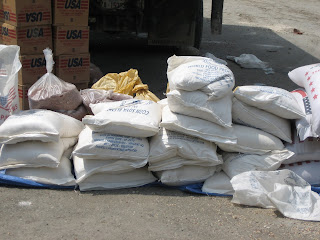
What do they get? The women receive a bag of 50 kg of rice between the two of them, a sack of pulses, cooking oil, and salt. Enough to create that quintessential Haitian diet, rice with beans, which I have been enjoying, sort of, for the last six, seven weeks. Or enough to sell it on the lively food market that has been established just outside the distribution compound and provide the necessary cash to survive another week, two weeks, or perhaps even more. Good for them!

(1) long cues are lined up outside the distribution compound, and not necessarily everybody has a coupon that lets them in, but they will wait anyhow, for hours, just on the off-chance that something will be left over at the end - even though we have explained the system to them over and over again.


(2) the distribution itself, people being let into the compound piecemeal to ensure an orderly process, and (3) the large sacks of rice and beans.


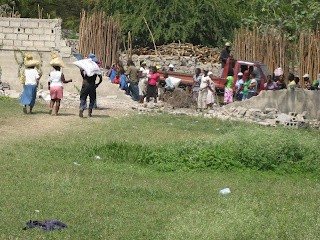
(4) after having received the food, people make their exit from the compound, helped by porters, to the street,

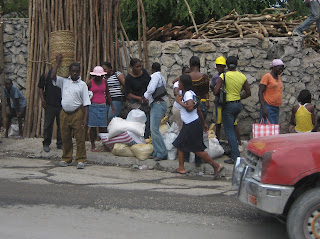
(5) where they wait for transport with their goods - or perhaps they are selling it right there and then.

Saturday, March 20, 2010

the president

Today I was invited for breakfast with the president. Really. Somehow, I have only met one president before, in my life, and that was president Bertrand Aristide, also of Haiti, some 8 or 9 years ago. It was a mixed experience, meeting someone so charismatic, yet frighteningly so. President Preval is a different person altogether.

But first the background. There is lots of discussion in Haiti, especially among government officials, about the role of NGO - non-governmental organisations, but you already know that acronym, do you? They do not coordinate well, they operate in isolation, they ignore government directives, in short, they need to be brought into the fold. Incidentally, this has been a issue for years, I remember that from my first time here, and it hasn't gone away; and with so much money flowing into the country, this sentiment has only grown stronger lately. There is something to say for this point of view, but this blog is perhaps not the right forum to discuss this. However, from the NGO perspective, reason enough to go and talk to the president.

So we did, the representatives of the nine biggest NGOs. In fact, we were invited by the president, for a breakfast meeting at 8 am in the palace, or in what is left of the palace. So I was picked up from home at 7 am, all dressed up with jacket and tie, for a rendezvous with the other heads of agencies at the back of the palace at 7.30. Security was tight, a big container blocks the entrance to the compound, but we managed to negotiate that one. The second check was from a list of names, and Mr Bruno was good enough to get us into the parking lot - even though it transpired later that Mr Bruno was not on the list. Walking on, we managed to pass the security to the next holding pen, before the real thing, the last level, complete with metal detector. Although, once again, my name was not on the list, I managed to get in assuming someone else's name: no identity cards here. In fact, control was pretty loose, because when we were standing there waiting for the rest of us to be cleared, a big black rat wriggled itself between our feet, and disappeared inside without having been properly identified, too. Really!

The meeting with the president was a delight. He is a very friendly, fatherly figure, at times making jokes, at times addressing you sternly, but someone you feel very comfortable with. A pat on the arm, a pat on the knee. Sure enough, informal, open-neck shirt... Nothing like my previous experience with a president! Preval was very interested in what we did - genuinely interested -, admitted that he did not know it all, was eager to learn about the way we work within the UN system, was firm but not pressing in making his points, which were all very reasonable. In short, an experience.

Only breakfast turned out to be disappointing: a cup of coffee only. No scrambled eggs, no fruit juice, perhaps we just had misunderstood the arrangements. But it didn't matter, we had one-and-a-half hours of his undivided attention - apart from the times he had to consult his Blackberry, but hee, which manager doesn't, these days, let along the manager of a country in distress? - and I think all of us, even the most skeptical, enjoyed the audience.


photos: (1) inside the presidential palace compound - just to prove I have been there - it is not different from anywhere else in Port-au-Prince, (2) apart from the fact that there is a special security unit, (3) of which, sadly, there is not much left - the remains of the Dessaline barracks.

Tuesday, March 16, 2010

the golfcourse

The Petionville Club was the country club for the Haitian elite. It had some 6 or 7 tennis courts and a nine-hole golf course, but many of its members were not necessarily playing any sports, were just a member to belong, to be part of the in-crowd. There were often parties in the large clubhouse, partly inside and partly on the terrace, and 'tout-le-monde' was there, it was the place to be seen. For those who played in was a challenging golf course, with mostly short holes, but hilly, with narrow fairways lined by trees. And even before the earthquake the last hole was occupied by squatters, so in effect it had become one of the very few eight-hole courses in the world, par 69.

Shortly after the quake the American army started to use the tennis courts for distribution of food and NFIs - non-food items, you 've got to get acquainted with the jargon: this means plastic sheeting, ropes, but also pots and pans, jerrycans, those things that people have lost in the disaster and ned to survive. The tennis courts were well suited for this, with high fences around them making access relatively easily controlled. So the golf course, a nice green patch around the corner from the distribution center, became the natural place for an IDP camp (you know by now what IDPs are, right?). And the camp has been growing ever since: official registration numbers suggest between 35-45,000 people live here, but most estimate the true number closer to 80,000. Taking into account the initial status of the 9th hole, that is 10,000 IDPs per hole.

What is going to happen to this camp is anybody's guess. Where you have so many people together you have to provide services, so somebody has dug latrines and created bathing areas. Others provide drinking water, which is being tankered in daily. Save the Children has set up a clinic, very popular even with people well outside the camp area because of its quality of service - and perhaps also because it is free. But when the rains come, and they will start in the next couple of weeks, all these people's tents and tarpaulins will be at risk, at risk of being washed away, at risk of being swept by mudslides. No drains, currently being created in anticipation, are going to handle the vast amount of water that is going to come down in one of those violent afternoon storms that I remember so well from 10 years ago. And yet, talking to the people in the camp on one of my recent visits, they seem to have no intention of moving. They are close to their neighbourhood, close to their jobs, close to where their children used to go to school (and hope to do so again when the schools re-open, on 1 April). Nobody knows how this is going to develop. But one thing is sure: this golf course has become a whole lot more challenging!!

(1) second and third fairway, dominated by tent hazards (special rules apply), (2) close-up of the second hole, even without tents a challenge, (3) snacks being sold on the path to the tee off for hole four, and (4) the lady looking for her ball....?

(5) water hazards: I don't know how many tankers a day are being trucked to the camp to provide drinking water.

(6) and another water hazard: latrines

(7, 8) Save the Children clinic, built on the tee of the fifth, with plenty of patients still waiting for services from the two doctors on call, and four nurses. The clinic includes a pharmacy, and there is also a baby tent, providing advise for pregnant women and allowing mothers privacy with breast feeding - no luxury in this overcrowded camp!

(9) and even the tennis courts are being used, in this case by the American army.

Sunday, March 14, 2010

the haircut

It was something I didn't have time to get done before I left: in between getting my tickets sorted out, my last vaccinations, and my critical purchases for survival in Haiti, getting my hair ready for the tropics was simply not a high enough priority at the time. But after a month or so, it really started bothering me - it is hot here, and long hair doesn't help -, so I have been looking for an opportunity to have my hair cut. Not easy. One day I didn't have the time (in fact, many days I didn't have the time), another day there was no car available (in fact, many days there was no car available), but finally, today, I just ignored all my other responsibilities, commanded a vehicle, and went to Salon Grimelde in Rue Faubert, Petionville. Recommended by friends of mine.

Right. Saturday morning is clearly grooming day for the Haitian elite. The place was packed, every chair was occupied. I indicated that I was, uhhm, somewhat in a hurry, but that was no problem. A folding chair was quickly arranged, and put right in the middle, and there we go. The lady hairdresser was from the Dominican Republic, so I switched to Spanish, in which I think I can better explain how I want my hair to be cut then in French. Some minutes later somebody had found a more comfortable chair, which was carried from the back, one of the customers was, with her chair and all, moved to the side, and an extra place was created in front of the mirror. And I moved, with partly cut hair, with towels and robe, from folding chair to comfi chair.

But it was not me that was of interest. Had I already told you that I was the only man? The rest of the place was packed with women, clearly the local upper class. No other foreigners. Many of these women must have been here for hours already; some had curls set, others were carefully having their hair touched up, and from quite a few others I have no idea what was being done to them. No less than seven women were sitting under huge hair dryers, and several had their nails manicured while waiting. And all of that whilst at least half of the clientele was happily chatting in their mobile phones. They all seem to know each other, they are pretty familiar with the hairdressers, too, probably come here every Saturday. It was quite a scene, one that at least kept me awake during the entire session - I normally fall asleep halfway.

Of course with all that entertainment I forgot to keep an eye on what was happening to my own head. Afterwards, I in fact thought it was quite OK, short, fast, and for European standards pretty cheap: what else do I need? But the comments I received after I got back to the office - especially Gina, our Haitian administration manager, cannot stop giggling every time I walk into her office -, are such that I have now decided not to post a new photo of myself for the foreseeable future....

Maybe I should try to explain in French next time.

Friday, March 12, 2010

the abduction

I was going to write about the restaurants. Last week, with so many visitors, I sampled some of the local eateries again, and it was as if nothing had changed from 10 years ago. La Plantation was packed, as always, and served excellent food, including Escargot de Kenscoff. Les Coins des Artist was, as always, good for a Lobster Brochette, and the selection of sauces put on the table was just like before. The only thing that had changed is that the animated French that used to be spoken at the tables was replaced by loud American English: the aid workers have taken over. Petionville, where most of the agencies have their local head quarters as well as their residences, has been invaded by foreigners, there have never been more expatriates in Haiti then ever before. Business is booming, and I could as well have gone to a dozen other restaurants. It was going to be an upbeat story.

No more. The kidnapping of two foreign aid workers last Friday has changed the scene, likely for a while. It was bound to happen. Haiti has a long history of kidnappings for ransom. When we were here before, it was the rich Haitian families that were targeted by the gangs. There were kidnappings every month or so. Later, after we left, it became worse, and at the height of the kidnapping wave, in 2007, it is said that there were as many as five abductions per day (really!!, Columbia is peanuts compared to the worst of Haitian talents). This was not just the rich families anymore, there are not that many rich families. But, through concerted effort of police and MINUSTHA - the UN troops here -, kidnapping gangs were identified and arrested, and life returned to slightly more normal again. Hardened criminals were put in jail.

The earthquake did two things. It made the prison collapse, allowing many of those criminals to escape. I have often said that there were more criminals outside than inside the prison, but apparently police had been successful, and the great escape is indeed a major setback. The quake also mobilised lots of money, which is going to be invested in this country through the aid agencies. The new targets.

The two women were abducted close to their office, in Petionville, early evening. It could have happened to anybody. The attack appears to have been professionally conducted, armed, masked men, quickly got to the car after briefly blocking the road. Professionals, clearly. The ordeal for the poor women, who like many of us came to help Haiti get back on its feet, lasted almost a week, they were released last night, unharmed. No news about ransom: hopefully nothing has been paid, not to encourage others. The good thing was that the story has been kept out of the news for almost a week, not to jeopardize the negotiations. (Now Reuters carries it, and AP, AFP and the Wall Street Journal.)

The response of almost all big aid agencies was swift: reduce the risk to staff, bring curfew forward etc. No more dining out. No more loud American accents. The boom that could have been has been smothered in the narrow interest of the criminal gangs. Haitian business suffers. And aid agencies might well start to think twice about their operating in Haiti, about their enthusiasm to rebuilt this country. What if nobody wants to come anymore?

What started as an upbeat story has, unfortunately, turned into identifying yet another challenge to the recovery of Haiti.
Sunday, March 7, 2010

the visits

One of the things one cannot avoid in my line of work is visits from important people from across the organisation. One such visit occurred recently when we received the CEOs of several Save the Children offices around the world for no less than three days. Another was that of a Senior Vice President, and the third was a delegation of five members of the Board of Trustees of Save the Children US - just for 24 hours.

Yours truly had been appointed senior disaster tour guide, which meant putting a program together, getting support from various staff members to buy-in to this program (i.e. ensure that people are present at school sites, or camp clinics, or meetings, presentations, other activities that were going to be visited), then changing the program to incorporate last-minute wishes, re-align the support from others as above, then changing the program back again to accommodate more last-minute wishes, and subsequently running the program against a tight time schedule. Key predictable unpredictables ("things we know we don't know") are airline delays and travel times on the ground - Port-au-Prince traffic is frequently blocked for prolonged periods of time. Key unpredictable unpredictables ("things we don't know that we don't know" - free after a former US Defense Secretary, who I now understand a lot better!) are the group dynamics of CEOs, the entirely different group dynamics of Board members, capricious changes in individual expectations, and unexpected last-minute cancellations from US Ambassadors, just hours after last-minute arrangements to include a visit to the US Ambassador.

Some of the objectives of such visits are, for instance, creating media material - essentially a video and photos of dignitaries interacting with earthquake-affected Haitian children -, which can then be used in interviews, and/or posted on the website of individual countries (check out the relevant Save website in your country). Or understanding the emergency response issues, and understanding our problems and challenges better; adding to these problems and challenges through their physical presence in-country seems a small price to pay. Or, my favourites, pep talks to the staff to show them the support the have from high-up in the organisation - really, most staff would much rather get on with their work, they have plenty to do.

However, before you mis-interpret my slight cynicism above, it has in fact been a fun exercise for most of the time: CEOs, VPs and Board members are all in fact very nice people, and invariably they are sharp - you don't have to explain much, you don't have to repeat yourself, and you can talk about grand visions, ideas, which I like. And most of them have a good sense of humour, too. Besides, by doing this well we have created some of the most powerful advocates for our efforts, and some very committed fundraisers. And then it suddenly becomes time well spent.